

WHAT IS SLAB-ON-GRADE FOUNDATION?
A slab-on-grade foundation is a structural engineering system where the foundation for a building (concrete slab) is created from a mold set into the ground. Concrete is then poured into the mold, leaving the concrete slabs lying directly on the ground over a prepared surface.
Slab-on-grade foundations are a popular choice for construction projects for a number of reasons. Not only do they provide numerous advantages to the owner and builder, but they are also cost-effective and easy to build.
This building method is commonly used:
- In warmer climates where frost lines are low.
- Where there is no need to install heat ducting beneath the floor (Tubing for radiant heat floor will work).
- Where there is no need for a basement.
This system provides structural integrity to support walls, upper floors, and load-bearing requirements, enabling the building project to be completed.
A slab-on-grade foundation must meet the concrete thickness requirements set by building engineers or architects and comply with the applicable building code, depending on the location.
BUILDING SLAB-ON-GRADE FOUNDATIONS
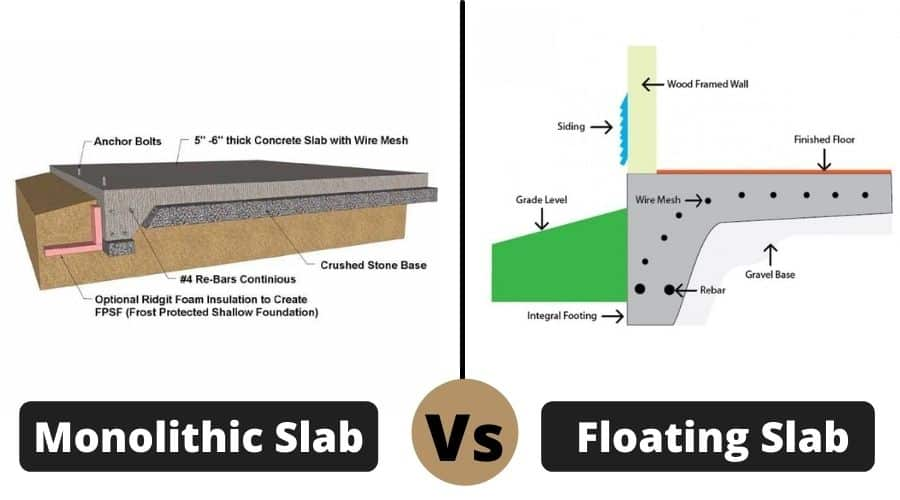
A home with a slab-on-grade foundation has no crawl space. The "slab on grade" is concrete poured over a layer of an approved vapor barrier material, usually placed on a gravel base to improve drainage. It is placed directly on the ground (grade) level. When the concrete is poured at once, it is called a "monolithic" slab. In this way, there are no breaks in the concrete between pours. Wire mesh is used to reinforce the concrete. The concrete's edge is poured to a greater thickness, and reinforcing rods are installed for a stronger perimeter.
Areas within the slab that bear more weight from above are made stronger by pouring a thicker layer of concrete. These variations are stipulated by engineering or architectural professionals to ensure building integrity and longevity.
SLAB-ON-GRADE HOUSE DESIGNS

Want to see slab-on-grade in action? Here are three of our house designs built on a slab-on-grade foundation. The 2 Bed 2 Bath Lake View Modern Cabin (1,598 sqft) is offered with a ready-to-build slab-on-grade option, framing the landscape from a single, grounded level. The 2 Bed 2 Bath Mini Barndominium (980 sqft) packs efficient, open living into a compact single-story footprint that sits naturally on a slab. And the 2 Bed 1.5 Bath Forest Modern Cabin (1,232 sqft) brings clean midcentury lines to a low-maintenance, slab-on-grade single-story home.
SLAB ON GRADE VS OTHER FOUNDATION SYSTEMS
The "slab on grade" foundation is highly efficient because the basic material serves dual purposes. The main disadvantage of a basement or stem wall foundation is that it requires much more excavation, which can be expensive depending on the site. Other than that, both basement and stem wall foundations use more concrete because of the walls. In the case of a basement, a lot of lumber is also needed to create the first-floor deck.
A foundation wall consists of a poured concrete footing followed by an 8-inch-thick foundation wall (can be thicker), typically 8 to 10 feet tall. In cold-climate zones, this basement foundation is buried below the frost depth to protect the footings and floor from freezing temperatures.
So, comparing a foundation wall with a slab-on-grade foundation, both systems lay directly on the ground or bedrock and should be properly insulated around the perimeter. One allows having basement space, and the other starts on the ground floor.
A crawl space foundation is a system elevated off the ground, creating a space between the house's first floor and the ground to allow "crawl" inside, providing access to wiring and plumbing for future maintenance. It consists of footings and walls (usually poured concrete) and is generally used for buildings on stable soil.
The main difference between a slab-on-grade foundation and a crawl space foundation is the house's elevation. Slab on grade is directly poured in the ground, and the finished level is only 8" above the grade, while crawl space features walls that elevate the building's level 18 inches or higher.
FLOATING SLAB AND MONOLITHIC SLAB
Floating slabs are called “floating” because they are permitted to move the ice line as a monolithic unit. Depending on the project's requirements, insulation can also be added to reduce movement caused by frost. It refers to a two-stage construction. Footings are poured independently, and the main slab floor is poured after the footings have cured.
One of the most affordable foundation construction methods is to develop a floating slab. Traditional foundations have a frost wall on top and a strip footing down the edge. The strip footing, typically 4 feet 0 inches below the ground, is positioned below the frost line.
On the other hand, the term Monolithic means "all in a single pour," so, in construction where Monolithic Slab is utilized, the foundation is constructed in a single pour that is made up of a layer of a concrete slab with the thicker fill region under the load-bearing walls and all the perimeter borders to replace the footer. it refers to a one-stage construction. Footings and the main slab floor are poured at the same time. This construction is faster and has lower labor costs as all is done at once.
Because the concrete is poured all at once in a Monolithic Slab, construction is faster, and labor expenses are lower. When used properly, Monolithic Slab can be just as sturdy as Stem-Wall slabs.

INSULATING A SLAB-ON-GRADE FOUNDATION
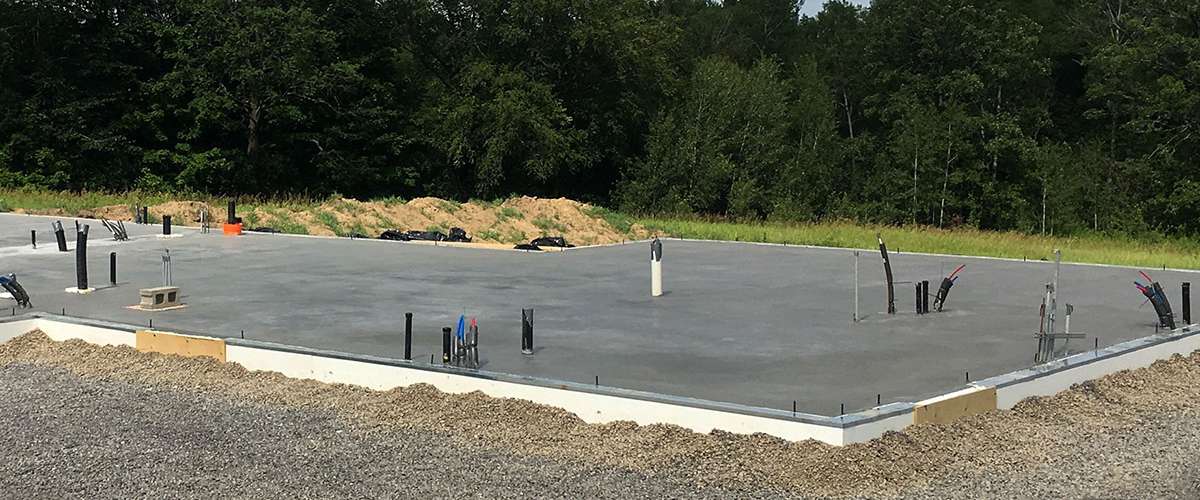
A frost-protection procedure is necessary and highly effective in cold climates. The slab is protected using two sheets of rigid polystyrene insulation on its perimeter, called skirt insulation.
By laying a piece of rigid foam flat at the bottom of the thicker concrete perimeter, abutting a horizontal piece of rigid foam, and on the outside wall of the slab itself, it effectively insulates the concrete, improving structural integrity by reducing the chances of the soil beneath freezing and cracking the slab. It also helps reduce heat loss, keeping the interior with a higher temperature. This foam can be used under the slab in more extreme cold areas.
This insulation method allows the footings (thicker concrete) around the perimeter and the slab to retain warmth from the home's heated area above. Frank Lloyd Wright started this method (1936). Even Sweden, Finland, and Norway began to use it after WWII. As a proven method, it answers many concerns and relieves us from the burden of digging a basement or installing deep footings.
ADVANTAGES OF SLAB ON GRADE
There are numerous advantages to using slab-on-grade foundations. For a detailed guide, check our blog post article The Benefit of a Slab on Grade Foundation Design – DesignwithFrank, among the advantages are:
- Affordability
- Comfort and efficiency
- Reduces problems caused by humidity and water infiltration
- Reduces environmental impact
- Solid foundation
- Less vulnerable to termites
DISADVANTAGES OF SLAB ON GRADE
The choice of foundation is one of many essential choices that must be made while constructing a new home. Slab-on-grade foundations are popular because they are cheaper and more convenient than other solutions. However, there are some drawbacks to this type of foundation that you need to be aware of. Among them are:
- Lack of access from below for installation lines
- Low house elevation
- Difficult to extend or remodel the slab foundation
- Plumbing systems are embedded in concrete, so plan your design!

DESIGN WITH ANTICIPATION WHEN USING SLAB ON GRADE FOUNDATION
When using this foundation system, saving space for mechanical systems and storage is essential. We recommend planning your design to create an efficient layout that includes: storage space, laundry facilities, a pantry, and a utility room. A mechanical room can be noisy, so these walls should include sound insulation measures.
Another important factor to consider is the plumbing system. Usually, this system can be accessed from the basement or crawl space, but not with a slab foundation. Plumbing systems are embedded in the concrete and are not easily modified. So, plan for the future! If you are thinking of creating a prospective bathroom, leave all preparations ready in your floorplan design.
When designing a slab-on-grade foundation, it is important to anticipate potential issues that could arise. These include soil settling over time, moisture problems, and ground expansion or contraction due to temperature changes. Some solutions involve incorporating a layer of crushed stone beneath the slab to prevent the settling of the soil. Add expansion joints in the design to allow for the development and contraction of the ground without damaging the slab.
A practical, good design should consider these issues and account for them. This way, the slab-on-grade foundation can be designed to last for many years.

SLAB ON GRADE AND SUSTAINABILITY
The slab on grade foundation can act as a huge thermal mass where the sun or radiant floor heating heats up the concrete and the concrete holds the heat for a prolonged period of time since concrete has a great mass. This reduces the temperature swing and improves the home energy efficiency without extra work.
Our design team often used slab-on-grade with clients in cold-climate states like Maine, Michigan, and Washington.
The idea of building a sustainable home goes hand in hand with the designer you choose to help you with your project. From start to finish, your design and build team should share completely in your vision for a sustainable home. A good designer, known for using eco-friendly products and procedures, is your best asset for determining a course of action.
SLAB ON GRADE IN ACTION: CEDAR SHINGLE MODERN FARMHOUSE IN MONROE, MAINE
See how these principles come together in a real build: our Cedar Shingle Modern Farmhouse in Monroe, Maine.
This home is designed and constructed to withstand the harsh winter weather of Maine, with heavy snowfall, ice storms, and strong winds. The entire building assembly is reinforced with ample insulation to preserve warmth and avoid heat losses. What makes the slab-on-grade foundation special here is the use of a Swedish frost-protected foundation system: it comprises three layers of 4-inch-deep XPS Type IV insulation set above 8 inches of compacted, crushed stone, protecting the slab from frost heave even in Maine's deep-freeze climate.
The floor uses a radiant heating system to maintain warmth indoors. The concrete slab above the foam insulation is embedded with heat-producing systems that transfer heat energy directly to people from the hot surface and to other objects via infrared radiation. Because the concrete slab has a substantial thermal mass, the floor heating works at maximum energy efficiency — a perfect example of the slab doing double duty as both structure and a heat battery for the home.

0 comments